
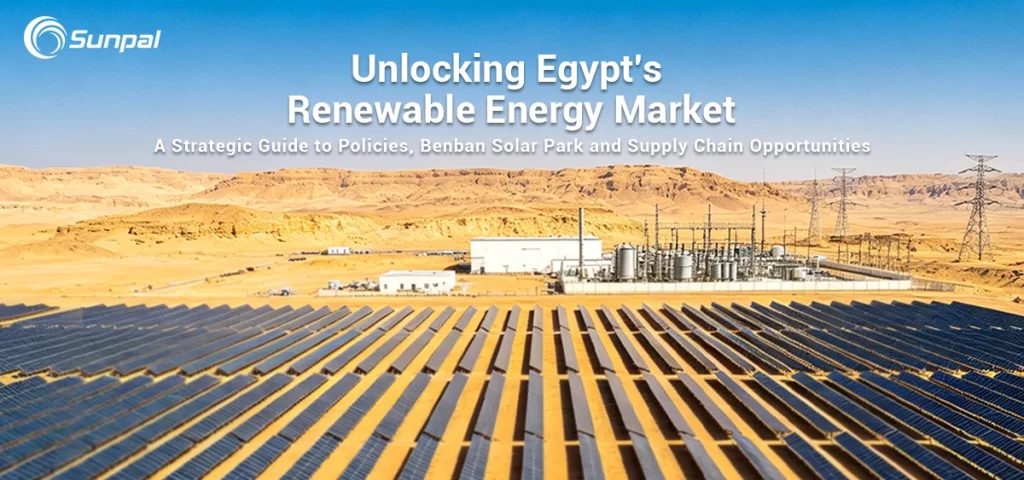
In April 2026, the European Bank for Reconstruction and Development announced a US$65 million construction bridging loan to HAU Energy for a landmark project in Egypt's Benban Solar Park near Aswan. The facility combines 200 MW of solar photovoltaic capacity with a 120 MWh battery energy storage system. Once online, it is expected to cut CO₂ emissions by up to 280,000 tonnes per year and strengthen the integration of variable solar power into the national grid.
This single transaction captures a larger shift underway across North Africa. Egypt is rapidly scaling utility-scale solar and solar-plus-storage projects, backed by clear policy targets, international development finance, and one of the world's most productive solar resources. For project developers, EPCs, equipment suppliers, and investors, understanding Egypt's renewable energy framework, the evolution of Benban, and the emerging supply-chain dynamics is no longer optional—it is essential.
This guide unpacks the policy landscape, the Benban ecosystem, the significance of the latest hybrid projects, and the practical opportunities and challenges along the solar value chain.
Egypt's Renewable Ambition: Policy Foundations and Market Momentum
Egypt's renewable energy journey rests on a solid legislative and strategic foundation. The Renewable Energy Law (Decree No. 203/2014) and the Electricity Law opened the door to independent power producers, long-term power purchase agreements, and build-own-operate models. These instruments, combined with competitive bidding, net metering options, and sovereign guarantees, have created a bankable environment for large-scale solar PV projects.
The Integrated Sustainable Energy Strategy originally targeted 42% renewable electricity by 2035. Egypt later brought this goal forward to 2030 in its updated Nationally Determined Contribution. Supporting programs such as the Nexus of Water, Food and Energy (NWFE) platform—particularly its energy pillar coordinated with the EBRD—aim to add 10 GW of new renewable capacity while retiring 5 GW of inefficient thermal generation. These efforts align with Egypt Vision 2030 and the National Climate Change Strategy 2050.
As of mid-2026, Egypt's installed renewable capacity stood at approximately 9.5 GW, comprising roughly 3 GW of hydropower, 3.5 GW of solar, and 3 GW of wind, alongside growing battery storage. The government has outlined clear near-term additions: further solar capacity and hundreds of megawatt-hours of storage by the end of 2026, with more ambitious targets for 2027 and beyond. Solar PV is expected to remain the fastest-growing technology, supported by world-class irradiation and a deepening project pipeline.
Incentives include customs duty relief on renewable equipment, tax advantages, streamlined land allocation through the New and Renewable Energy Authority, and preferential treatment for projects that incorporate higher local content. The Golden License mechanism further accelerates permitting for strategic investments. Together, these measures reduce development risk and improve project economics for utility-scale solar and hybrid solar-plus-storage schemes.
Egypt Renewable Energy Capacity Growth (2020–2026)
Approximate installed capacity in MW for Hydro, Solar PV and Wind, with Battery Storage shown separately in MWh. Solar and wind lead Egypt's recent renewable expansion, while storage is emerging as a rapidly growing category.
Egypt targets 42% renewable electricity generation by 2030
The national target has been advanced from the original 2035 timeline. Renewable capacity growth is increasingly driven by utility-scale solar and wind, while battery storage is beginning to support grid flexibility and renewable integration.
capacity by end-2026*
Benban Solar Park: From Flagship Complex to Hybrid Power Hub
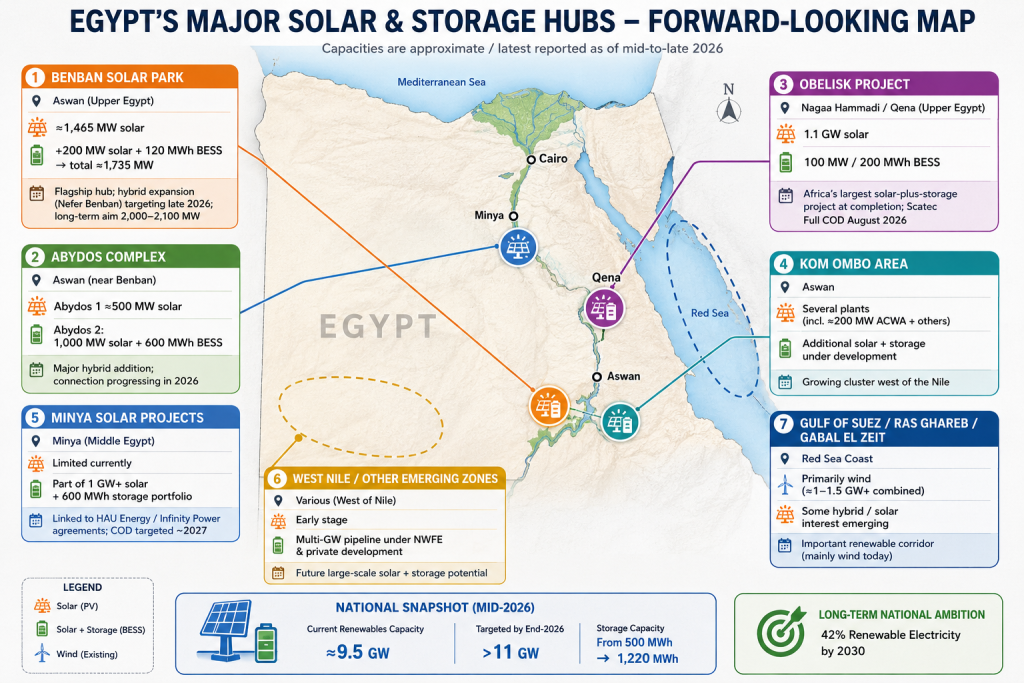
Located roughly 40 km northwest of Aswan in Egypt's Western Desert, the Benban Solar Park occupies approximately 37 square kilometres of high-irradiation land. It ranks among the largest solar complexes globally. By early-to-mid 2026 its operational capacity had reached about 1,465 MW across more than 30 individual plants developed by international and local sponsors under 25-year PPAs with the Egyptian Electricity Transmission Company.
The site benefits from exceptional solar resources—high global horizontal irradiation, long sunshine hours, and relatively low seasonal variability—making it ideal for both fixed-tilt and single-axis tracking systems. Early phases relied on feed-in tariff and competitive processes that attracted major international financing from institutions such as the IFC and EBRD. The park has already demonstrated the viability of multi-developer mega-sites and has become a reference model for large-scale solar deployment in emerging markets.
Benban is now entering its next chapter. Expansions under construction or advanced development are set to push capacity toward 1,735 MW in the near term, with longer-term ambitions approaching 2,000–2,100 MW. Critically, new projects are incorporating battery energy storage systems. The addition of storage addresses intermittency, improves grid stability, enables better matching of generation with demand, and increases the overall value of the solar asset. Neighbouring developments such as the large Abydos projects further reinforce Upper Egypt as a clean-energy corridor.
Spotlight on the 200 MW Solar-Plus-Storage Project
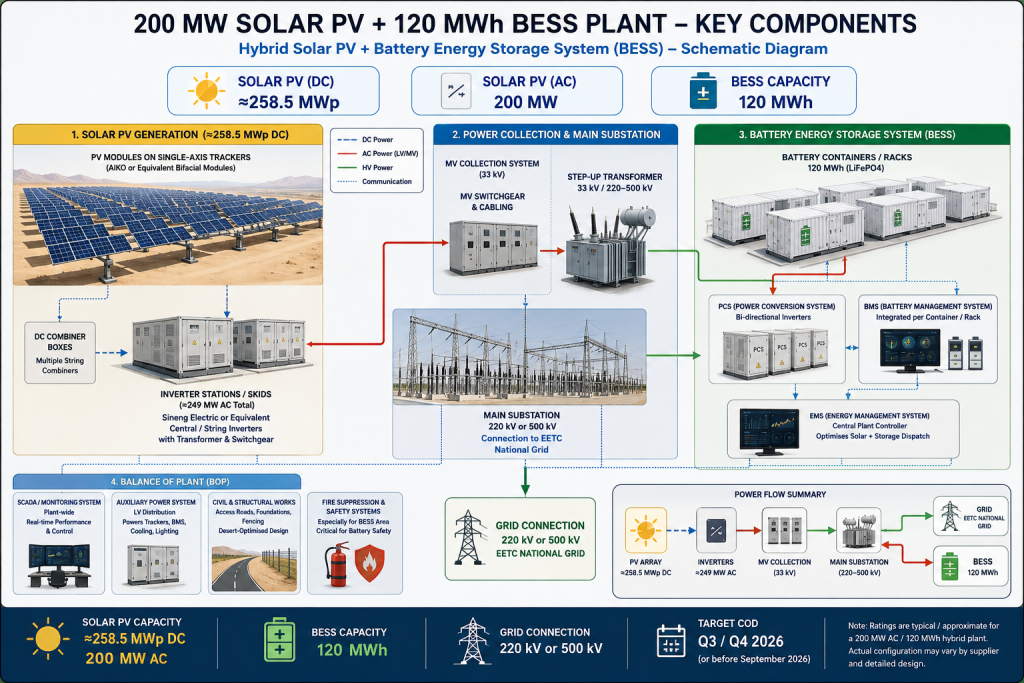
The HAU Energy project—co-developed with Infinity Power—exemplifies the hybrid model now gaining traction. The 200 MW (approximately 258 MWp) solar PV plant paired with 120 MWh of battery storage sits within or adjacent to the Benban ecosystem. The EBRD's US$65 million bridging loan covers a significant portion of the engineering, procurement, and construction phase. Total project cost is estimated in the US$175–180 million range.
Once commissioned (targeted for late 2026), the facility will supply clean electricity to the national grid, support technical skills training programs for local youth, and serve as a proof point for future solar-plus-storage deployments under the NWFE framework. It forms part of a broader portfolio that includes additional gigawatt-scale solar and storage capacity elsewhere in Egypt. Contractors involved include established local and international players for EPC, trackers, inverters, and modules—illustrating the collaborative nature of today's utility-scale projects.
This configuration reflects a global trend: pure solar is increasingly paired with storage to enhance bankability, meet grid-code requirements, and unlock higher offtake value. For suppliers of high-efficiency modules, robust trackers, central or string inverters, and modular containerised BESS solutions, projects of this scale represent clear commercial opportunities.
Navigating the Supply Chain: Opportunities and Realities in Egypt and North Africa
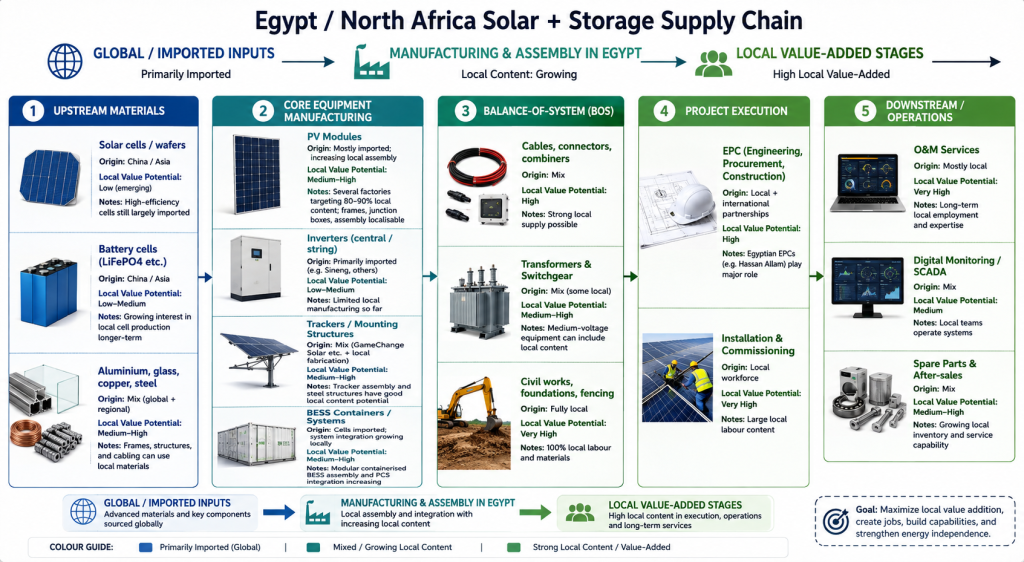
Egypt's rapid solar expansion is reshaping regional supply chains. While high-efficiency solar cells and advanced battery cells are still largely imported, localisation is accelerating. Government targets encourage higher local content—often in the 40–60% range for projects seeking specific incentives—with particular focus on frames, junction boxes, cables, mounting structures, and eventually modules and storage systems. Several solar panel manufacturing initiatives are moving toward production, and battery manufacturing interest is rising, including potential large-scale BESS assembly facilities.
Logistics corridors from Mediterranean and Red Sea ports to Aswan are well established, though desert conditions demand careful attention to dust mitigation, temperature resilience, and reliable O&M. Developers and EPCs increasingly favour equipment that meets international standards and DFI requirements (EBRD, IFC, etc.), including proven performance in high-irradiance, high-temperature environments and strong warranty packages.
Key opportunities for international suppliers include:
- High-power, bifacial, and high-efficiency modules suited to desert conditions.
- Reliable single-axis trackers engineered for sandy terrain.
- Utility-scale inverters and medium-voltage solutions.
- Modular, long-cycle-life LiFePO4 or similar BESS systems that support daily cycling and grid services.
- EPC, O&M, and digital monitoring services that improve asset performance.
Challenges remain: currency considerations, certification processes, skilled labour availability for specialised installation, and the need to balance imported technology with growing local-content expectations. Successful market entrants typically combine competitive technology with local partnerships, robust after-sales support, and a clear understanding of grid-connection and financing requirements.
Strategic Outlook: Positioning for the Next Wave of Growth
Egypt's combination of policy clarity, excellent solar resources, an established mega-park platform at Benban, and rising demand for hybrid solutions positions it as one of the most attractive renewable energy markets in North Africa and the broader Middle East–Africa region. The pipeline of solar and solar-plus-storage projects is substantial, with further potential linked to green hydrogen ambitions and regional interconnections.
For stakeholders the implications are clear. Project developers and EPCs should prioritise hybrid designs that incorporate storage from the outset. Equipment suppliers must demonstrate reliability under harsh desert conditions and willingness to support localisation goals. Investors and financiers can leverage DFI co-financing structures and the growing track record of bankable PPAs.
The recent EBRD-backed 200 MW project is both a concrete milestone and a signal of direction: international capital is flowing toward well-structured solar-plus-storage assets in Egypt. Companies that combine deep market knowledge with proven technology and strong execution partnerships will be best placed to capture the opportunity.
Practical Pathways for Suppliers and Developers Entering the Egyptian Market
For solar companies and technology providers looking to convert market insight into concrete opportunities, several practical pathways stand out. Establishing early relationships with established Egyptian EPCs and local partners can significantly reduce execution risk, particularly around logistics, permitting, and workforce mobilisation in Upper Egypt. Many successful international suppliers have found that offering modular, containerised battery energy storage solutions alongside high-efficiency solar modules creates a stronger value proposition for hybrid projects of the type now advancing at Benban and elsewhere.
Engagement with development finance institutions remains another high-leverage route. Projects that meet EBRD, IFC or similar environmental, social and technical standards often benefit from smoother financing and greater offtaker confidence. Suppliers whose equipment already carries the necessary certifications and performance track records in high-temperature, high-dust environments are better positioned to be specified in bid packages. At the same time, demonstrating a clear plan for supporting local content—whether through assembly partnerships, training programmes or progressive localisation of components—aligns with national industrial policy and can improve competitiveness in tenders.
Finally, companies should monitor the evolving interface between utility-scale solar-plus-storage and Egypt's emerging green hydrogen ambitions. As large renewable energy zones expand and grid infrastructure is reinforced, surplus daytime solar generation paired with storage could increasingly serve industrial offtakers and hydrogen production facilities. Positioning product portfolios and service offerings with this longer-term integration in mind will help suppliers capture not only the current wave of hybrid projects but also the next phase of Egypt's energy transition.
Conclusion
Egypt's renewable energy story is still being written, but the outline is already visible. Supportive policies, the proven platform of the Benban Solar Park, and the rapid adoption of solar-plus-storage configurations have created a compelling opportunity for companies across the value chain. The EBRD-backed 200 MW project is both a concrete milestone and a leading indicator of the market's evolution. Success will favour those who combine accurate market intelligence, reliable and bankable technology, and a willingness to partner locally. For developers, suppliers and investors prepared to engage with seriousness and long-term commitment, North Africa—and Egypt in particular—offers one of the most promising growth theatres in the global energy transition.
Ready to explore opportunities in Egypt’s solar and energy storage market? Partner with Sunpal to access reliable solar and storage solutions, flexible project configurations, and long-term technical support tailored to your market needs. Get in touch with our team to discuss your next project.