
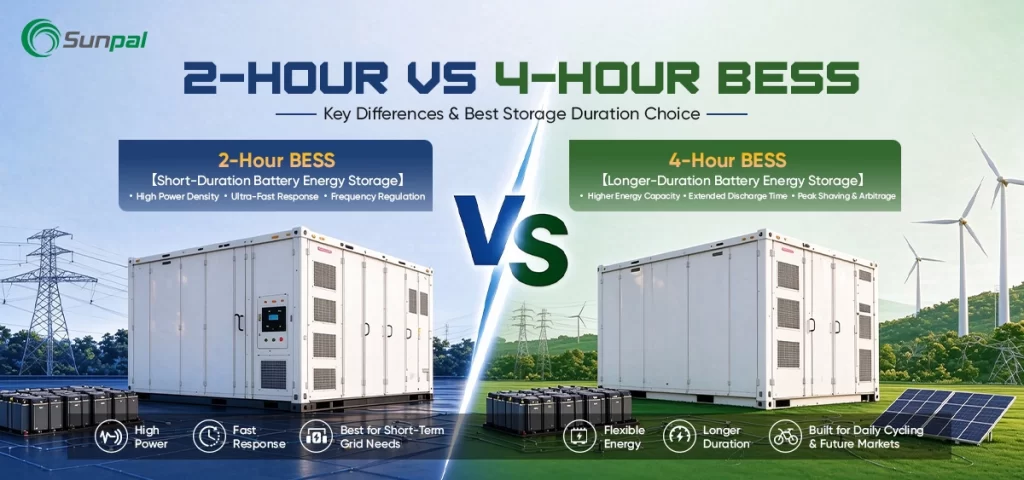
Battery energy storage systems are transforming how solar power is captured, shifted, and delivered. As solar farms and commercial rooftops generate more midday electricity than the grid or on-site loads can immediately use, the question of storage duration has moved from technical detail to strategic decision. More and more people increasingly ask the same practical question: is a 2-hour or a 4-hour battery energy storage system the smarter choice for today's solar-plus-storage projects?
There is no universal winner. The right duration depends on the shape of the solar generation curve, the length of the evening peak, local market rules, capacity payments, land constraints, and total project economics. This article examines the technical differences, real-world applications, cost structures, and market trends so you can match duration to project needs with greater confidence.
What Duration Really Means in a Battery Energy Storage System
Duration is simply usable energy capacity divided by the system's sustained discharge power. A 100 MW / 200 MWh system can deliver its full rated power for roughly two hours. A 100 MW / 400 MWh system can sustain that same power for about four hours. The label is an energy-to-power ratio, not a guarantee of perfect performance under every operating condition.
In lithium iron phosphate (LFP) systems commonly paired with solar, this often corresponds to different C-rates. A typical 2-hour configuration operates near 0.5C, while a 4-hour system sits closer to 0.25C. The distinction matters because power-related equipment—power conversion systems (PCS), transformers, switchgear, and grid interconnection—does not scale linearly with energy capacity. Adding more battery modules and containers increases energy storage without proportionally increasing those fixed power costs.
Understanding this relationship prevents two common mistakes: treating “longer duration” as automatically superior, or selecting duration solely by container count rather than by the actual duty cycle the solar project will face.
2-Hour vs. 4-Hour BESS: Power and Energy Capacity Comparison
100 MW / 200 MWh vs. 100 MW / 400 MWh
Power Versus Energy: The Core Design Trade-Off
When comparing 2-hour and 4-hour battery energy storage systems, it is essential to state whether power or energy is held constant. At equal power, the 4-hour system requires roughly twice the energy capacity and therefore more cells, racks, and containers. At equal energy capacity, the 4-hour system delivers lower sustained power.
This trade-off affects several practical factors. Higher-power 2-hour systems can respond quickly to short, sharp price spikes or demand peaks and can often charge or discharge more aggressively when solar surplus appears suddenly. Longer-duration 4-hour systems spread delivery across a wider window, which aligns better with multi-hour evening net-load peaks created by high solar penetration. Thermal management loads, auxiliary power consumption, and the intensity of cycling also differ. A system that discharges more slowly may experience different stress patterns on cells and cooling systems than one that cycles harder over shorter periods.
Round-trip efficiency, cycle life, and degradation are influenced more by operating strategy, depth of discharge, temperature control, and EMS sophistication than by the duration label alone. High-quality liquid-cooled LFP systems from experienced integrators perform well in both configurations when properly designed and controlled.
Containerized BESS: Component Breakdown and Scaling
Interactive System Architecture | 2-Hour vs. 4-Hour Configuration
Battery Racks / Modules / Cells
Primary Function
Store and release electrical energy using LFP battery cells.
Scaling Behavior
Scales directly. Approximately twice the number of battery modules and racks are required when energy capacity doubles.
Where Each Duration Excels in Solar Projects
Solar energy storage applications fall into several recurring patterns, and duration should match the pattern rather than follow fashion.
Two-hour systems often suit sites with short, intense demand peaks or markets that still reward fast-response ancillary services. Commercial and industrial facilities facing brief afternoon demand spikes, EV charging hubs with concentrated load windows, or projects focused on frequency regulation and short-term balancing can extract strong value from higher relative power. In some markets, the lower absolute energy capacity of a 2-hour system reduces upfront capital while still covering the critical hours.
Four-hour systems have become the workhorse for many solar-plus-storage projects because they better match the typical solar generation profile. Midday solar surplus can be stored and then released across a three-to-five-hour evening peak when wholesale prices or retail rates are highest. Utility-scale solar farms, large commercial rooftops with sustained late-afternoon and evening loads, and projects seeking capacity or resource-adequacy payments frequently favor the longer window. The extra energy capacity also provides greater operational flexibility for multi-use strategies that combine energy arbitrage, peak shaving, and backup power.
Hybrid solar systems and microgrids introduce additional considerations. When the goal is higher solar self-consumption or longer islanding capability, the additional stored energy of a 4-hour system can improve resilience and reduce reliance on diesel generators. Conversely, if interconnection capacity is limited or land is expensive, a leaner 2-hour design may allow more projects to move forward within the same physical footprint.
2-Hour vs. 4-Hour BESS
How Battery Duration Changes Solar Energy Shifting
The Economics of Duration: CAPEX, LCOS, and Revenue
Capital cost is the most visible difference. Power-related equipment is largely shared. Energy-related costs—cells, packs, containers, and associated balance of system—scale with duration. As a result, a 4-hour system typically costs substantially less than twice a comparable 2-hour system on a total project basis and often appears cheaper on a dollars-per-kilowatt-hour metric because fixed costs are spread over more energy.
Recent industry cost surveys have shown turnkey prices for four-hour systems frequently coming in lower per kWh than two-hour systems. The gap has narrowed further as cell prices have declined and manufacturing scale has improved. Levelized cost of storage (LCOS) analyses similarly indicate that well-utilized 4-hour assets can achieve competitive or superior figures in many markets, especially when capacity payments or multi-hour arbitrage value are available.
Revenue potential is more nuanced. In markets with multi-hour evening price spreads driven by solar penetration, the extra two hours of discharge often capture meaningful additional energy revenue. Capacity markets and resource adequacy programs in several regions grant higher effective load-carrying capability or de-rating factors to longer-duration resources, improving the capacity revenue stack. Ancillary service revenues, once a primary driver for shorter-duration batteries, have compressed in many saturated markets, reducing one historical advantage of 2-hour systems.
Payback and internal rate of return therefore depend on the specific revenue stack. Modeling that holds power constant and varies energy capacity frequently shows the 4-hour configuration delivering stronger returns when evening peaks last three or more hours and capacity accreditation is material. The reverse can hold when the value is concentrated in very short high-price events or when capital is severely constrained.
Other lifetime costs matter as well. Augmentation strategies, degradation under different cycling intensities, land and civil works, and financing terms all influence the final comparison. Professional system integration and a capable energy management system can improve utilization for either duration and often matter more than the raw hour rating.
2-Hour vs. 4-Hour BESS: CAPEX & LCOS Comparison
100 MW Project | Illustrative 2025–2026 Cost Estimates
Market Trends Pushing Toward Longer Duration
Across major solar markets, average installed duration has been rising. High solar penetration creates longer periods of low midday prices followed by extended evening net-load peaks. Policy and market design have reinforced the shift: several U.S. independent system operators and other capacity mechanisms treat four hours as a reference duration for full capacity credit. Tender documents in multiple countries increasingly specify or favor four-hour systems for solar-paired and standalone storage. Falling battery costs have made the incremental energy capacity more affordable, turning what was once a premium option into the default for many new projects.
At the same time, shorter-duration systems continue to find niches. Certain commercial and industrial applications, constrained interconnection points, and markets still valuing rapid response keep demand for 2-hour configurations alive. Looking further ahead, even longer durations (six to eight hours and beyond) are entering the conversation for deeper renewable firming, yet the 2-hour versus 4-hour choice remains the practical decision for the large majority of lithium-ion projects being developed today.
Data-center growth, electrification of transport and heating, and continued solar expansion are all increasing the value of reliable multi-hour capacity. Projects that can deliver energy across the critical evening window are better positioned to capture both energy and capacity value streams.
BESS Duration & Solar-Plus-Storage Growth Trends
Illustrative market trends from 2021 to 2026, showing the shift toward longer-duration battery storage and expanding solar-plus-storage deployment.
Average Duration of New BESS Installations
Annual average duration in hours. U.S. ranges are displayed as midpoint estimates; hover over each point to view the full estimated range.
Annual U.S. Solar-Plus-Storage Additions
Illustrative annual additions. Power capacity (GW) and energy capacity (GWh) use separate vertical axes. Hover over each bar to view the estimated range.
Illustrative trends based on industry reports and market observations through 2026. Figures are approximate estimates, not a standardized statistical dataset. 2026 values represent year-to-date, early data, or projections as indicated. Actual figures vary by source, region, and project definition.
A Practical Framework for Choosing Duration
Selecting the right battery energy storage duration starts with the project's actual operating profile rather than a preferred product specification.
First, map the solar generation curve against the load or price profile. Identify the length and shape of the high-value discharge window and the available charging window. Second, clarify the primary value streams—energy arbitrage, peak shaving, demand charge reduction, capacity payments, solar self-consumption, or backup. Third, run comparative models that hold power constant and vary energy capacity (and vice versa), using realistic CAPEX, degradation, efficiency, and forward price assumptions. Fourth, factor in site constraints: available land, interconnection capacity, permitting timelines, and noise or visual requirements. Fifth, stress-test the results against changes in price spreads, capacity market rules, and utilization rates. Finally, consider the role of software. An advanced EMS can extract more value from either duration through better forecasting, optimal dispatch, and multi-use stacking.
In practice, many utility-scale solar-plus-storage projects and larger commercial installations land on four-hour systems because the extra energy capacity aligns with evening peaks and improves capacity accreditation. Two-hour systems remain competitive where peaks are short, capital is limited, or power-oriented services dominate. Hybrid approaches or modular designs that allow future energy augmentation offer a middle path for projects with evolving requirements.
BESS Project Characteristics vs Recommended Duration
Compare project conditions to identify whether a 2-hour, 4-hour, or flexible / hybrid BESS configuration is the better starting point. Select any matrix cell to view its rationale.
| Project Characteristic | Favors 2-Hour BESS | Favors 4-Hour BESS | Flexible / Hybrid | Rationale / Notes |
|---|---|---|---|---|
| Peak / High-Value Window | 2-HourShort peaks (1–2.5 hours) | 4-HourMulti-hour peaks (3–5+ hours) | FlexibleVariable or mixed peaks | Match discharge duration to the high-price or high-load period. |
| Primary Application | 2-HourAncillary services, short demand-charge spikes | 4-HourSolar shifting, TOU arbitrage, capacity value | FlexibleArbitrage + ancillary + backup | Value-stream alignment is the strongest driver. |
| Solar Generation Profile | 2-HourLimited surplus or sharp solar peaks | 4-HourSustained midday surplus shifted into evening | FlexibleModerate solar with flexible loads | 4-hour systems can capture and deliver larger solar energy volumes. |
| Capacity Market / ELCC Rules | 2-HourLow or no duration requirement | 4-HourHigher credit for ≥4-hour resources | FlexiblePartial credit scaling | Longer duration may receive better capacity accreditation. |
| Capital / Budget Constraint | 2-HourLower absolute CAPEX preferred | 4-HourBudget supports higher energy capacity | FlexiblePhased or modular investment | 2-hour usually costs less in total; 4-hour may improve cost per kWh and project returns. |
| Site / Interconnection Limits | 2-HourLimited land or interconnection capacity | 4-HourAdequate space and grid headroom | FlexibleModular expansion planned | More energy capacity generally requires more battery equipment and footprint. |
| Backup / Resilience Needs | 2-HourShort backup window sufficient | 4-HourLonger backup window desired | FlexibleVariable critical-load requirements | Duration directly affects how long power can be sustained. |
| Daily Cycling Intensity | 2-HourHigher cycle count, shorter windows | 4-HourModerate cycling, longer windows | FlexibleSoftware-optimized multi-use | Cycling intensity affects degradation and augmentation planning. |
| Market Price Shape | 2-HourSharp, short price spikes | 4-HourBroader multi-hour price spreads | FlexibleEvolving price patterns | 4-hour systems can capture more extended evening spreads in high-solar markets. |
| Project Type | 2-HourSome C&I and ancillary-focused projects | 4-HourUtility solar-plus-storage, large C&I shifting | FlexibleHybrid projects with future optionality | Many solar-paired projects lean toward 4-hour configurations. |
Project Duration Preference Assessment
Select the conditions that best describe your project. The scores count selected indicators, not a financial or engineering simulation.
Looking Ahead: Matching Duration to the Solar Future
The solar industry is moving from intermittent generation toward firm, dispatchable renewable power. Battery energy storage is the enabling technology, and duration is one of the most consequential design choices. Four-hour systems currently offer the broadest fit for solar energy shifting, multi-hour arbitrage, and capacity products in most major markets. Two-hour systems continue to serve focused applications that prioritize power density and lower absolute energy cost. The “better” duration is the one that maximizes value for the specific site, market, and commercial structure.
As cell costs continue to fall, software improves, and market rules evolve, project teams that model duration rigorously—rather than defaulting to habit—will build more resilient and profitable solar-plus-storage assets. High-quality system integration, thermal management, and intelligent controls remain essential regardless of the hour rating chosen.
Whether you are developing a utility-scale solar farm with co-located storage, a commercial rooftop seeking higher self-consumption, or a standalone battery project supporting the grid, the decision between 2-hour and 4-hour BESS deserves careful, data-driven analysis. The right match between solar generation, storage duration, and market opportunity is what turns intermittent sunshine into reliable, valuable power.
Ready to choose the optimal BESS for your solar project? Explore Sunpal's advanced battery energy storage solutions and get expert guidance tailored to your needs. Visit us at www.sunpalsys.com.