
Introduction
Australian mining giant Fortescue Metals Group is accelerating one of the world's most ambitious off-grid renewable energy initiatives in Western Australia's Pilbara region. The project integrates massive solar and wind generation with a 4–5 GWh battery energy storage system (BESS) to deliver reliable, clean power to energy-intensive iron ore operations. Phase 1 targets 1 GWh of storage capacity by the end of 2025, with full deployment creating a benchmark for industrial microgrids.
This pioneering effort highlights a growing trend: GWh-scale battery storage is becoming essential for heavy industry's energy transition. It reduces reliance on diesel and gas, lowers operating costs, enhances energy security, and supports net-zero goals. For project developers, mining operators, and renewable energy companies, phased deployment from 1 GWh to 5 GWh offers a practical, lower-risk path to large-scale systems.
This article provides a comprehensive guide to planning and selecting large-scale energy storage systems for off-grid and hybrid applications.
The Rise of GWh-Scale Energy Storage in Heavy Industry
The global battery energy storage market is experiencing explosive growth. Installations reached record levels in early 2026, with quarterly additions exceeding 9 GWh in some periods and annual demand projections approaching 450 GWh. Utility-scale and industrial segments lead this expansion, driven by rapidly falling battery prices, strong policy support, and the urgent need to integrate high volumes of variable solar and wind power.
In heavy industry, particularly mining, large-scale BESS addresses unique challenges: remote locations far from main grids, extremely high continuous power demands, and exposure to volatile diesel and gas prices. Off-grid solar-plus-storage systems, often paired with existing thermal assets, create resilient microgrids capable of 24/7 operation with minimal fossil fuel use.
Fortescue's project in the Pilbara stands as a landmark example. It combines over 1 GW of solar capacity, substantial wind resources, and up to 5 GWh of battery storage to power mining operations independently of the traditional grid. Recent progress includes the start of construction on a 690 MW solar farm paired with a 650 MWh BESS, marking concrete steps toward full off-grid capability.
Such projects demonstrate that industrial energy storage has moved beyond pilot stages into mainstream deployment. Similar initiatives are emerging across Australia and other resource-rich regions, signaling robust demand for scalable, high-reliability solutions in mining, remote industrial sites, and large renewable energy bases. This trend creates significant opportunities for solar companies and storage providers specializing in off-grid energy storage and hybrid microgrid systems.
Global BESS Annual Deployment Growth (2020–2030)
Data in Gigawatt-hours (GWh) — Utility, Industrial & Commercial Scale
Strategic Planning for Phased Deployment
Phased deployment has emerged as the smartest approach for GWh-scale projects. It minimizes upfront capital risk while allowing progressive optimization based on real operational data. Fortescue's strategy — beginning with 1 GWh before scaling to 4–5 GWh — enables early wins and reduces exposure to unforeseen challenges.
Key Benefits of Phased Deployment:
- More manageable capital allocation across multiple budget cycles.
- Lower overall project risk through iterative learning and adjustments.
- Faster initial ROI from early-phase capacity.
- Simplified regulatory approvals by proving concept at smaller scale.
Step-by-Step Planning Framework:
- Detailed Load Profiling — Conduct thorough energy audits of mining or industrial operations, mapping 24/7 demand patterns, peak loads from processing plants, and variable requirements for haulage fleets.
- Renewable Resource Assessment — Use advanced modeling to evaluate solar irradiance, wind patterns, and hybrid generation potential across seasons. Digital twin technology helps simulate system behavior under different weather scenarios.
- Capacity Sizing Methodology — Begin with 1–2 GWh for initial solar shifting and grid stabilization. Gradually expand to 4–5 GWh to achieve higher renewable penetration and multi-hour autonomy. Duration requirements (typically 4–8 hours or more) should align with critical backup needs.
- Hybrid Integration Strategy — Design seamless interoperability with existing gas or diesel generators for backup power and black-start functionality.
- Realistic Timeline Development — Set clear milestones, including procurement, construction, testing, and optimization periods between phases. Account for supply chain realities and local permitting timelines.
- Stakeholder Alignment and Risk Management — Engage EPC contractors, technology providers, financiers, and regulators from day one. Perform comprehensive scenario modeling covering demand growth, commodity price fluctuations, and extreme weather events.
Modular system designs that support incremental expansion are particularly valuable, enabling projects to grow efficiently without major redesigns. This approach has proven highly effective for large-scale off-grid solar energy storage applications worldwide.
Typical Phased Deployment Timeline: 1 GWh to 5 GWh BESS Project (2025–2028)
Phased approach reduces risk and enables continuous optimization
Phase 0 (2025 Q3–Q4)
0 GWh → Feasibility & Financing
Permitting • Site prep • ContractsPhase 1 (2025–2026)
1.0 GWh added
Procurement • Installation • CommissioningPhase 2 (2027)
2.5 GWh cumulative
Expansion • Optimization • Data reviewPhase 3 (2028)
5.0 GWh full scale
Full integration • EMS optimizationSystem Selection Criteria for GWh-Scale BESS
Choosing the right technology stack determines long-term performance, safety, and economics in demanding industrial environments.
Battery Chemistry remains the foundational decision. LiFePO4 (Lithium Iron Phosphate) has become the dominant choice for utility-scale and industrial large-scale battery storage projects. Its superior thermal stability, long cycle life (often exceeding 6,000 cycles), and inherent safety characteristics significantly reduce fire risks compared to other lithium-ion variants, making it ideal for GWh-scale installations.
Modular Containerized Designs offer unmatched flexibility. Standardized 20- or 40-foot containers allow projects to start at MW/MWh scale and expand smoothly to multi-GWh capacity. These systems simplify logistics, site installation, and future maintenance — critical advantages for remote mining locations.
Power Conversion and Control Systems are equally important. High-capacity bidirectional inverters must support both grid-tied and off-grid (grid-forming) operation. Advanced Energy Management Systems (EMS) use AI-powered forecasting, real-time weather data, and load prediction algorithms to optimize charging and discharging strategies continuously.
Additional critical selection criteria include:
- Comprehensive safety systems with multi-layer protection and early-warning mechanisms.
- Robust thermal management solutions capable of handling extreme ambient temperatures common in mining regions.
- High round-trip efficiency (targeting 85–95%) and low auxiliary power consumption.
- Strong manufacturer warranties, performance guarantees, and proven degradation curves.
- Full compatibility with solar PV inverters, wind turbines, and legacy generators.
For solar companies and industrial end-users, prioritizing systems with demonstrated success in off-grid energy storage and heavy industrial applications ensures smoother project execution and better long-term outcomes.
Battery Chemistry Comparison for Large-Scale Industrial Energy Storage
Why LiFePO4 is the Preferred Choice for GWh-scale Off-Grid and Mining Projects
| Parameter | LiFePO4 (LFP) | NMC (Nickel Manganese Cobalt) | NCA (Nickel Cobalt Aluminum) | Lead-Acid (Advanced) |
|---|---|---|---|---|
| Safety | Excellent (Very Low thermal runaway risk) | Moderate (Higher fire risk) | Moderate-High | Good |
| Cycle Life | 6,000 – 10,000+ cycles | 2,000 – 4,000 cycles | 1,500 – 3,000 cycles | 500 – 1,500 cycles |
| Calendar Life | 15 – 20+ years | 10 – 15 years | 8 – 12 years | 5 – 8 years |
| Energy Density (Wh/kg) | 140 – 180 | 200 – 250 | 220 – 260 | 30 – 50 |
| Cost per kWh (2026 est.) | $80 – $110 (Lowest) | $110 – $150 | $130 – $170 | Very Low (short life) |
| Thermal Stability | Excellent (stable up to 60°C+) | Moderate | Moderate | Good |
| Depth of Discharge (DoD) | 90 – 100% | 80 – 90% | 80 – 90% | 50 – 70% |
| Maintenance | Very Low | Low | Low | High |
| Environmental Impact | Lower (no cobalt, recyclable) | Higher (cobalt & nickel) | Higher (cobalt) | High (lead) |
| Suitability for Industrial Off-Grid / Mining | Excellent | Good (but safety concerns) | Moderate | Poor (short life) |
Technical Architecture of a 1–5 GWh Off-Grid System
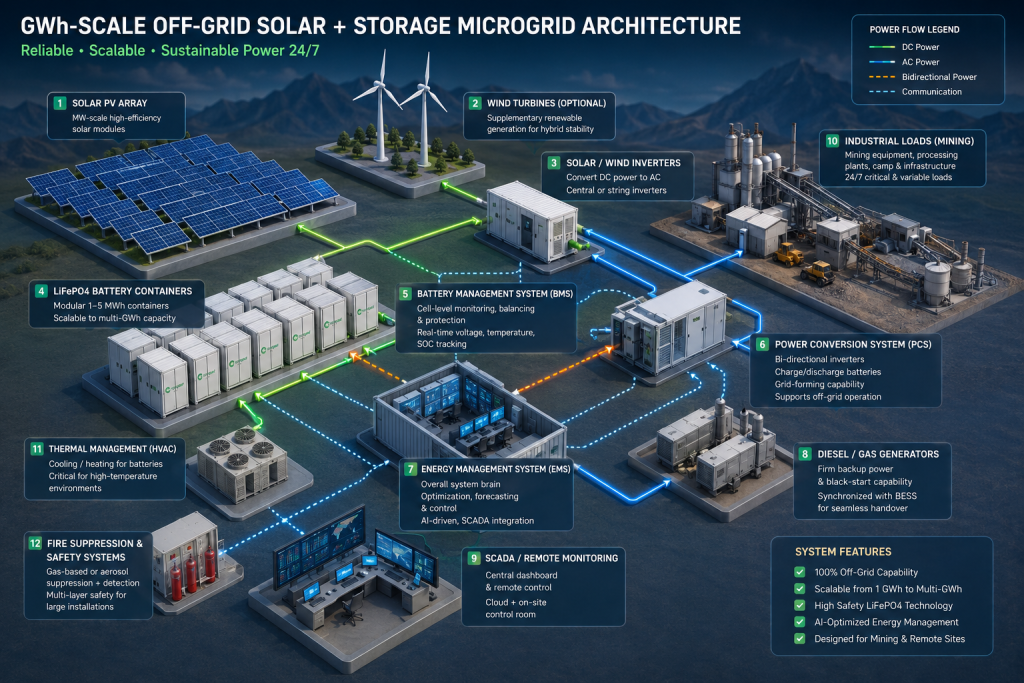
A robust GWh-scale off-grid system consists of tightly integrated layers working in harmony:
- Generation Layer: Large solar PV arrays and wind turbines deliver variable renewable power through high-efficiency inverters.
- Storage Core: Thousands of LiFePO4 battery cells organized into racks, clusters, and containerized units. Sophisticated Battery Management Systems (BMS) provide cell-level monitoring, balancing, and protection.
- Power Electronics: Scalable Power Conversion Systems (PCS) manage bidirectional energy flow and deliver grid-stabilizing services such as frequency and voltage regulation.
- Intelligent Control Layer: A central EMS acts as the brain of the microgrid, making split-second decisions to balance supply, storage, and demand.
- Backup and Resilience Layer: Existing gas or diesel generators provide firm capacity, with automatic seamless transfer capabilities.
In full off-grid mode, the system must maintain stable frequency and voltage independently. Advanced controls enable black-start sequences and islanded operation even during extreme conditions. For mining sites, additional engineering focuses on dust and particulate protection, high-temperature resilience, and remote diagnostic capabilities.
The modular “Lego-like” architecture allows capacity to be added incrementally without disrupting ongoing operations, perfectly supporting phased deployment strategies in large-scale energy storage projects.
Economic Analysis and Investment Justification
Large-scale energy storage projects deliver compelling economics through fuel savings, increased renewable utilization, demand charge reduction, and enhanced operational resilience.
Phased deployment significantly improves financial profiles by spreading investment while delivering early benefits. Phase 1 capacity can immediately displace expensive diesel generation, generating positive cash flow that helps fund subsequent phases.
Key metrics to evaluate include Levelized Cost of Storage (LCOS), project IRR, and payback periods (typically 4–8 years depending on local diesel prices and incentives). Sensitivity analysis should cover battery price trends, energy throughput, and potential carbon pricing mechanisms.
Financing options have matured rapidly, including green bonds, dedicated project finance facilities, and government support programs for industrial decarbonization. Over the long term, these systems also increase asset value through lower emissions, stronger ESG performance, and greater energy independence.
Cumulative Costs vs Savings: Phased vs Single-Stage 5 GWh Deployment
Phased approach delivers faster payback and lower initial capital burden
Want to run your own numbers?
Try our free Large-Scale BESS ROI Calculator — estimate payback period, IRR, and lifecycle savings.
Challenges, Risks, and Mitigation Strategies
Common challenges include supply chain volatility, performance in harsh environments, complex permitting, and cybersecurity threats. Effective mitigation involves selecting experienced partners, implementing rigorous factory and site testing, using proven modular components, and deploying advanced monitoring platforms. Early stakeholder engagement and phased rollouts further reduce overall project risk.
Future Outlook and Industry Implications
The GWh-scale BESS sector is poised for continued strong growth as technology costs decline and policy support expands. Mining and heavy industry are expected to remain key drivers, creating substantial opportunities for companies specializing in industrial microgrid solutions and off-grid solar energy storage systems.
Conclusion and Call to Action
Fortescue's ambitious project proves that phased deployment makes multi-GWh battery storage systems both technically feasible and economically attractive for heavy industry. By following structured planning processes, selecting appropriate LiFePO4-based technologies, and optimizing system architecture, organizations can achieve reliable, low-carbon power at scale.
The journey from 1 GWh to 5 GWh provides flexibility and continuous improvement. As the industry advances, these projects will set new standards for mining, renewable energy integration, and remote operations worldwide.
Planning a large-scale off-grid or hybrid energy storage project? Sunpal's modular containerized LiFePO4 BESS solutions deliver the safety, scalability, and integration capabilities required for industrial success.Contact our team of solutions engineers today for tailored system design and product selection support. Get our comprehensive GWh-Scale Industrial Off-Grid Storage Project Guide to access detailed frameworks, cost models, and practical insights.