
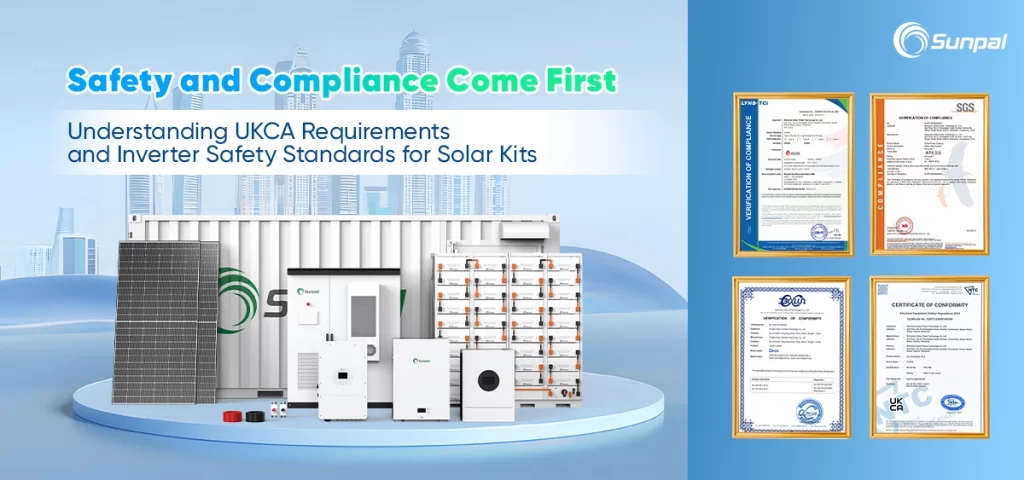
Introduction
The UK is on the cusp of a solar revolution. In March 2026, the government announced plans to legalise plug and play solar kits for households, making it possible for ordinary families to generate their own clean energy by simply plugging a compact system into a standard wall socket. This move promises to slash energy bills, empower renters, and accelerate the nation's journey toward net zero. But with great accessibility comes an even greater emphasis on safety.
For distributors, installers, and forward-thinking homeowners searching for plug and play solar kit UK options, understanding the regulatory landscape is essential. At the heart of compliance lie the UKCA mark and rigorous micro inverter safety standards. This comprehensive guide explores exactly what solar kits must meet to thrive under the new framework — and how reputable suppliers are already preparing compliant solutions.
Understanding Plug-and-Play Solar Kits in the UK Context
Plug-and-play solar systems, sometimes referred to as balcony solar or portable solar kits, represent a user-friendly approach to renewable energy. A typical setup includes one or more high-efficiency solar panels connected to a compact micro-inverter that converts direct current (DC) into alternating current (AC) suitable for household use. The entire system connects via a standard three-pin UK plug, eliminating the need for fixed wiring in many cases.
Prior to the regulatory changes, installing such systems legally in the UK required hiring a qualified electrician for a dedicated circuit, submitting G98 notifications to the Distribution Network Operator (DNO), and ensuring full compliance with wiring regulations. These steps added cost and complexity, deterring many potential users. The new framework, updating G98 and BS 7671, will permit self-installation of compliant systems up to around 800W, provided they meet predefined safety criteria.
Key benefits include:
- Rapid deployment — often installable in under an hour.
- Lower entry costs compared to full rooftop systems.
- Suitability for rented properties where permanent modifications are impractical.
- Potential annual generation of 200–500 kWh or more, depending on location and orientation.
- Contribution to energy independence and reduced reliance on fossil fuels.
Despite these advantages, the technology carries inherent risks if poorly implemented. Overloading circuits, inadequate anti-islanding protection, or substandard components could lead to electrical faults, fire hazards, or grid disturbances. This is why the government is proceeding carefully, with a strong focus on product standards and user guidance.
As of July 2026, the final details following the recent consultation period are expected soon, with full market availability anticipated shortly thereafter. Early indications suggest simplified notification processes for compliant kits rather than full prior approvals for very small systems.
For the solar industry, this development opens substantial opportunities. Searches for how to sell plug and play solar in uk, solar kit for rented property uk, and related terms are rising sharply. Distributors and installers who align with compliant products will be well-positioned to serve both consumer and business-to-business demand. Sunpal, with its focus on international standards and quality manufacturing, is actively developing solutions tailored to these exact requirements.
UK Plug-and-Play Solar Legalisation Timeline (2026)
From Announcement to Safe Market Rollout • Safety First with UKCA & G98 Compliance
Core Certification Requirements: UKCA Marking Explained
The UKCA mark is the cornerstone of product compliance for the Great Britain market. Introduced after the UK's departure from the European Union, it replaced the CE mark for most goods placed on the market in England, Scotland, and Wales. UKCA signifies that the manufacturer or importer has verified the product meets all applicable UK statutory requirements for safety, health, and environmental protection.
For solar photovoltaic equipment, relevant legislation includes the Electrical Equipment (Safety) Regulations 2016, Electromagnetic Compatibility Regulations, and specific product standards. The marking applies to complete plug and play kits as well as individual components such as panels, micro-inverters, and cabling.
The UKCA compliance process typically involves:
- Identification of all applicable UK regulations and designated standards.
- Risk assessment and technical file compilation, including test reports from accredited laboratories.
- Drawing up a Declaration of Conformity (DoC) that lists the standards met.
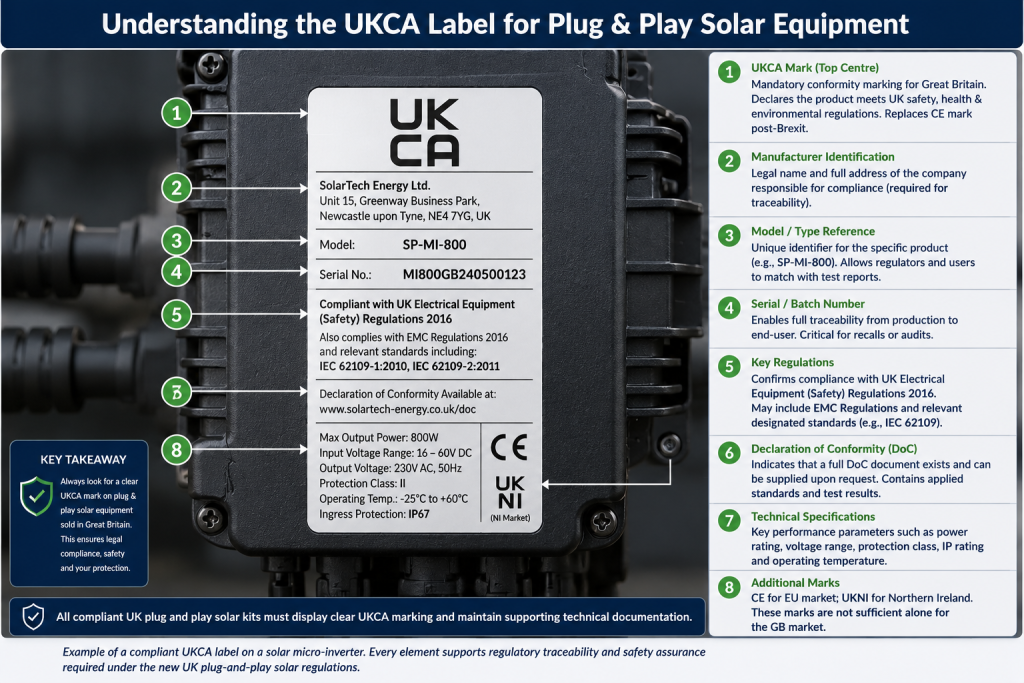
- Affixing the UKCA symbol visibly, indelibly, and legibly on the product, packaging, or accompanying documentation.
- Retaining technical documentation for at least 10 years for potential inspection by market surveillance authorities.
In the context of UKCA certified solar panels and inverters, testing often references IEC standards adapted for UK use, such as IEC 61215 for PV module performance, IEC 61730 for module safety, and IEC 62109 for inverter safety. Traceability is crucial — every component in the supply chain must support the overall conformity claim.
Distributors must exercise due diligence. Importing non-UKCA products or mixing compliant and non-compliant parts can result in products being withdrawn from sale, fines, or reputational damage. This is especially relevant for online marketplaces and retailers preparing for the plug-and-play surge.
Common challenges include language barriers with overseas factories, varying interpretations of standards, and ensuring that plugs and connectors meet British-specific requirements (e.g., BS 1363 for plugs). Professional suppliers address these by maintaining UK-specific product variants and providing full documentation packages to their partners.
The UKCA framework not only ensures safety but also levels the playing field for responsible manufacturers. Companies that invest in proper certification demonstrate commitment to the UK market and gain trust from both consumers and regulators. For businesses searching for ukca certified solar panels for distributors, partnering with experienced producers streamlines market entry and reduces compliance risk.
Inverter Safety: The Heart of Compliant Plug-and-Play Systems
Micro-inverters form the technological and safety core of any effective micro inverter for plug and play system. Unlike central string inverters used in larger arrays, micro-inverters are installed at the panel level, converting DC power to AC close to the source. This architecture improves efficiency, especially under partial shading, and significantly enhances system safety.
For UK plug-and-play applications, the micro-inverter must reliably limit output, protect the household circuit, and interact safely with the national grid. The primary regulatory reference is G98, which sets technical requirements for connecting small-scale embedded generation (up to 16A per phase / 3.68 kW). For sub-800W systems, simplified compliance pathways are anticipated.
Essential safety features include:
- Anti-islanding protection: Rapid detection of grid failure and automatic shutdown within seconds to protect utility workers.
- Voltage and frequency monitoring: Continuous checking against UK grid parameters with automatic disconnection outside safe limits.
- Power quality management: Low harmonic distortion and compliance with strict limits to prevent interference with other appliances.
- Over-temperature and fault protection: Thermal sensors and automatic power reduction or shutdown.
- Integrated DC isolation and residual current detection: Minimising shock and fire risks.
These functions are evaluated under standards such as IEC 62109-1 and IEC 62109-2 for inverter safety, alongside UK grid code elements. Certified units are typically listed on the ENA Type Test Register, providing independent verification.
The advantages of micro-inverters over alternatives become clear in small DIY-style installations. Module-level electronics allow individual panel monitoring and optimisation, reduce high-voltage DC cabling runs, and improve overall system resilience. In a plug-and-play context, the inverter must also incorporate a compliant UK plug and clear status indicators for the end user.
Poor-quality or uncertified inverters pose serious risks, including failure to disconnect during outages, overheating due to inadequate cooling, or generation of dangerous harmonics. Cases reported in other markets highlight the importance of proper certification before widespread adoption.
For UK-focused suppliers, inverters destined for this market often feature additional user-friendly elements such as app-based monitoring, export limiting capabilities, and robust weatherproofing (IP67 or higher). When evaluating options, distributors should request full test reports, warranty details (typically 10–25 years for quality units), and evidence of ongoing conformity.
Sunpal's micro-inverter range is designed with these exact UK requirements in mind, offering G98-aligned performance, UKCA documentation support, and high reliability for plug-and-play configurations. This preparation allows partners to bring products to market quickly once regulations are fully enacted.
How a Compliant Micro-Inverter Works in a UK Plug & Play Solar Kit
Safety-first architecture with UKCA + G98 compliance | Real-time protection + plug-in simplicity
| Feature | Micro-Inverter (Recommended) | String Inverter | Winner |
|---|---|---|---|
| System Size | 200W – 800W plug & play | 1kW – 10kW+ | Micro-Inverter |
| Installation | Plug directly into socket | Electrician required | Micro-Inverter |
| Safety (Anti-Islanding) | Per-module instant shutdown | System-level shutdown | Micro-Inverter |
| Shading Performance | Independent panel MPPT | Whole string affected | Micro-Inverter |
| Monitoring | Panel-level real-time data | System-level only | Micro-Inverter |
| DC Safety Risk | Low-voltage short DC runs | High-voltage DC strings | Micro-Inverter |
| Fire Risk | Very low (fast shutdown) | Higher under fault conditions | Micro-Inverter |
| Scalability | Modular expansion | Rewiring required | Micro-Inverter |
| UK G98 Compliance | Optimised for <800W systems | Over-designed | Micro-Inverter |
| Maintenance | Replace single unit | Single point failure | Micro-Inverter |
Additional Essential Standards and Components for Full Compliance
Achieving full regulatory approval requires attention to every element of the solar kit. Solar panels must satisfy mechanical load, thermal cycling, and humidity-freeze tests outlined in relevant IEC standards, while carrying clear UKCA marking. Cabling requires appropriate cross-sectional area, insulation ratings, and UV resistance for outdoor use in line with BS 7671 wiring regulations.
Connectors, particularly MC4 or equivalent DC types, must be correctly rated and securely mated to prevent arcing. AC-side components, including the plug itself, must conform to British Standards. Surge protection devices and proper earthing provisions further reduce risks from lightning or grid transients.
While the smallest plug-and-play systems may follow simplified routes, many distributors pursue MCS (Microgeneration Certification Scheme) recognition for broader market acceptance and installer confidence. Environmental considerations such as RoHS and WEEE compliance are also expected.
A practical compliance checklist for buyers should cover power limiting mechanisms, user manuals with safety warnings, installation guidance, and maintenance instructions. Combining the core kit with compatible battery storage (e.g., LiFePO4 systems) can enhance self-consumption and provide backup capability without compromising the primary plug-and-play simplicity.
Comprehensive Compliance Checklist for UK Plug and Play Solar Kits (≤800W)
All components must meet mandatory UK requirements for legal sale and installation. UKCA marking is compulsory.
| Category | Requirement | Type | Technical Standard / Description | Compliance Status |
|---|---|---|---|---|
| UKCA Marking | Product conformity marking | MANDATORY | UKCA logo must be visible, permanent, and traceable on product or packaging | — |
| UKCA Documentation | Declaration of Conformity | MANDATORY | Legal document listing all applicable UK regulations and applied standards | — |
| Solar Panels | Electrical safety certification | MANDATORY | IEC 61215 / IEC 61730 or equivalent UK designated standard compliance | — |
| Solar Panels | Environmental durability | MANDATORY | Wind load, snow load, UV resistance, thermal cycling tests | — |
| Micro-Inverter | UKCA certification & technical file | MANDATORY | Full compliance documentation with traceable test reports | — |
| Micro-Inverter | G98 grid compliance | MANDATORY | Anti-islanding, voltage/frequency protection, harmonic control | — |
| Micro-Inverter | Electrical safety standard | MANDATORY | IEC 62109-1 / 62109-2 or UK equivalent safety standard | — |
| Micro-Inverter | Power output limitation | MANDATORY | Maximum AC output ≤ 800W as per UK plug-in regulation | — |
| Cabling System | DC photovoltaic cables | MANDATORY | UV resistant, double insulated, correctly rated PV wiring | — |
| Cabling System | AC plug & household connection | MANDATORY | BS 1363 compliant UK 3-pin plug system | — |
| Cabling System | MC4 connectors | MANDATORY | IP67+ weatherproof DC connectors with correct rating | — |
| Protection Systems | RCD / isolation protection | RECOMMENDED | Leakage current protection for enhanced user safety | — |
| Protection Systems | Surge protection device (SPD) | RECOMMENDED | Lightning and surge protection for AC/DC circuits | — |
| Documentation | User installation manual | MANDATORY | Clear English instructions for safe installation and usage | — |
| Documentation | Technical compliance file | MANDATORY | Full test reports available for authorities and distributors | — |
| Documentation | Warranty coverage | MANDATORY | Minimum warranty clearly stated (10–25 years depending on component) | — |
| Product Labelling | Rating & safety labels | MANDATORY | Model number, serial number, voltage, warnings clearly displayed | — |
| Optional Features | Battery compatibility | OPTIONAL | Support for LiFePO4 home energy storage integration | — |
| Optional Features | Monitoring application | OPTIONAL | Real-time generation, alerts, and performance tracking | — |
| Optional Features | Mounting kit | OPTIONAL | Balcony or ground installation support system | — |
| System Limit | Total AC power cap | MANDATORY | Entire system must not exceed 800W output limit | — |
| Certification | MCS certification | RECOMMENDED | Optional certification improving market acceptance and credibility | — |
Implications for Distributors, Installers, and End-Users
The plug-and-play solar segment creates new revenue streams for distributors and installers while offering accessible clean energy to end-users. Businesses can differentiate themselves by providing fully documented, UKCA-ready kits supported by marketing materials and technical training.
End-users benefit from lower barriers but should still assess roof/balcony suitability, orientation, and local planning rules (especially in conservation areas). Simple ROI calculations often show payback within 5–8 years depending on electricity prices and generation.
Distributors should focus on supply chain reliability, customer education, and after-sales support. Complementary offerings such as mounting solutions, monitoring apps, and storage integration add value.
Conclusion and Call to Action
The forthcoming UK regulations for plug and play solar kits, underpinned by UKCA marking and stringent inverter safety standards, represent a balanced approach to innovation and protection. By prioritising certified, high-quality components, the industry can deliver safe, effective renewable solutions to thousands of households.
Sunpal stands ready as a trusted partner with compliant products, documentation, and expertise. Explore our UK-ready solutions, download detailed compliance guides, or contact our team for tailored quotations and partnership opportunities. Embrace the future of accessible solar — safely and confidently.