
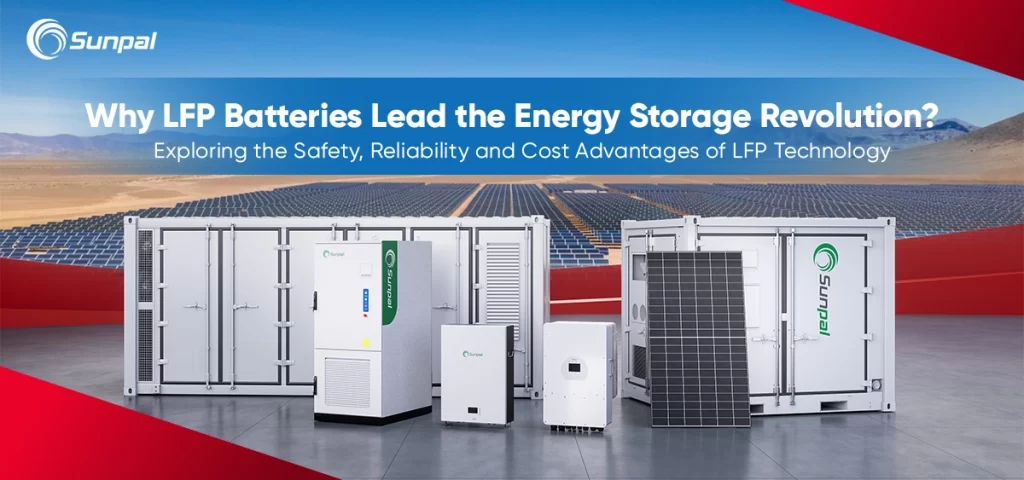
Introduction
As global energy storage and EV projects scale rapidly in 2026, Lithium Iron Phosphate (LFP) batteries have surged to become the dominant choice for top developers and automakers. In 2025, LFP overtook nickel-based chemistries to claim the largest share of global EV battery deployments, while accounting for roughly 90% of new battery energy storage system (BESS) installations.
What explains this decisive shift? LFP delivers unmatched safety, dramatically lower lifetime costs, exceptional longevity, and resilient supply chains — making it ideal for utility-scale solar storage, commercial and industrial (C&I) projects, residential solar-plus-storage, and mass-market EVs. While it trades some energy density for these benefits, cell-to-pack innovations and system-level optimizations have closed performance gaps for most real-world applications.
This in-depth analysis explores the technical, safety, economic, and strategic drivers behind the global move to LFP and its implications for solar installers and project developers worldwide.
The Rise of LFP: From Niche to Global Standard
LFP technology has evolved from a niche chemistry used mainly in low-power applications to the cornerstone of the modern energy transition. Early lithium-ion batteries relied heavily on nickel-manganese-cobalt (NMC) and nickel-cobalt-aluminum (NCA) cathodes because they offered higher energy density. However, starting around 2020, extreme price volatility in nickel and cobalt, coupled with growing safety concerns and the urgent need for cost-effective solutions for mass renewable integration, triggered a rapid shift toward LFP.
By 2025, the transformation was unmistakable. LFP surpassed nickel-based chemistries globally in EV battery deployments for the first time. Industry reports showed LFP demand growing at 48% year-over-year — the fastest pace among all battery chemistries. In China, LFP powered more than 80% of new electric vehicles sold. Globally, its share exceeded 55% of total EV battery capacity and approached 90% in stationary storage applications.
This rapid rise is particularly relevant to the solar energy industry. Solar installers and developers increasingly pair photovoltaic systems with energy storage to manage intermittency, participate in demand response programs, and provide backup power. In these scenarios, LFP’s strengths in longevity and safety far outweigh its moderate energy density disadvantage.
The chemistry benefits from abundant, low-cost raw materials — iron and phosphate — which are far less geopolitically sensitive than cobalt or nickel. This abundance has enabled manufacturers to scale production aggressively, driving down costs and improving supply chain stability for solar project developers worldwide.
LFP has become the practical standard for projects where reliability, safety, and economics matter most.
Global Battery Chemistry Shift in Solar + Storage Projects
LFP has become the dominant chemistry for both electric vehicles and stationary energy storage due to superior safety, cost effectiveness, and long cycle life.
Global LFP Market Share Growth (2020–2026)
LFP Overtakes Nickel-Based Batteries in 2025Regional LFP Adoption Ranking (2025)
LFP Dominance in Stationary Energy Storage
Key Industry Insight
LFP has transitioned from a China-focused battery chemistry into the global standard for utility-scale solar + storage projects. Its superior safety profile, lower cost, and extended cycle life make it the preferred choice for grid-scale and commercial BESS deployments worldwide.
Technical Comparison: LFP vs. NMC and Other Chemistries
Understanding why top projects choose LFP requires a clear technical comparison with dominant alternatives.
Key Comparison Table:
| Metric | LFP | NMC/NCA | Winner for Solar Storage |
| Energy Density (Wh/kg) | 120–180 | 180–270 | NMC (gap closing) |
| Cycle Life (to 80% SOH) | 4,000–10,000+ | 1,000–4,000 | LFP |
| Depth of Discharge | 80–100% | 80–95% | LFP |
| Thermal Runaway Onset | ~270°C+ | ~150–210°C | LFP |
| Cost (2025–2026, pack) | ~$70–$81/kWh | ~$108–$128/kWh | LFP |
| Temp Range (Discharge) | -10°C to +50°C+ | -10°C to +45°C | LFP |
| Round-Trip Efficiency | 90–95% | 90–94% | Tie |
| Self-Discharge | ~1.5–3%/month | ~2–4%/month | LFP |
LFP’s LiFePO4 cathode provides a stable olivine crystal structure that excels in durability. Its nominal voltage is lower (3.2V vs. ~3.6–3.7V for NMC), contributing to lower energy density. However, for stationary solar storage applications — where weight and volume are less critical than longevity — this is rarely a limitation.
Cycle Life Advantage: Premium LFP cells routinely achieve 6,000–10,000 cycles, enabling 15–25+ years of service in daily solar cycling. NMC systems typically last 1,000–4,000 cycles, requiring earlier replacement. In solar+storage, LFP’s high depth-of-discharge tolerance (often 95–100% usable) maximizes energy delivered from every installed kWh.
Temperature Performance: LFP handles high temperatures better with slower degradation above 35°C and maintains strong performance in hot climates common for solar farms. Cell-to-pack designs, advanced silicon anodes, and modular architectures have narrowed the energy density gap, making LFP competitive even in space-constrained C&I installations.
For solar installers, LFP means simpler system design, fewer replacements, and better long-term project economics. Innovations continue to push LFP boundaries, with LMFP (lithium manganese iron phosphate) hybrids offering higher density while retaining core advantages.
LFP vs NMC for Solar Energy Storage Systems
Comparing safety, lifecycle, cost effectiveness, usable energy and climate adaptability based on 2025–2026 industry data.
Interactive Technology Comparison
Core Technical Comparison
| Metric | LFP (LiFePO4) | NMC | Winner |
|---|---|---|---|
| Energy Density | 120–180 Wh/kg | 180–270 Wh/kg | NMC |
| Cycle Life | 4,000–10,000+ | 1,000–4,000 | LFP |
| Depth of Discharge | 95–100% | 80–90% | LFP |
| Thermal Runaway | ~270°C+ | 150–210°C | LFP |
| Pack Cost | $70–81/kWh | $108–128/kWh | LFP |
| Calendar Life | 15–25+ Years | 10–15 Years | LFP |
Cycle Life Comparison
Pack Cost Comparison
Usable Capacity (10 kWh Battery)
Climate Performance Heat Matrix
Key Industry Takeaways
In-Depth Safety Analysis
Safety remains the single most compelling reason for LFP adoption in populated or critical solar installations.
LFP’s olivine crystal structure provides exceptional thermal stability thanks to strong phosphorus-oxygen bonds, releasing minimal oxygen during thermal stress. Thermal runaway onset occurs at approximately 270°C versus 150–210°C for NMC, with much lower peak temperatures and slower propagation.
Comparative Abuse Test Results:
- Nail penetration and overcharge: LFP cells typically show no fire or explosion; NMC frequently does.
- Mass loss during runaway: LFP ~14–21% vs. NMC ~45–65%.
- Propagation speed: Up to 5–9 times slower in LFP modules.
Implications for Solar Projects:
- Reduced fire suppression and spacing requirements, lowering installation costs.
- Lower insurance premiums and easier permitting, especially for residential and rooftop C&I systems.
- Safer deployment near homes, schools, and commercial buildings.
- Better alignment with stringent UL, IEC, and local fire codes.
Real-world data shows significantly fewer thermal incidents with LFP systems. This builds confidence for large-scale deployments where public safety and regulatory approval are critical.
For solar companies, specifying LFP translates to lower risk, higher customer satisfaction, and stronger project bankability.
Cost-Effectiveness and Lifecycle Economics
LFP wins decisively on total cost of ownership (TCO) for solar energy storage.
Upfront Advantages: Abundant iron and phosphate materials keep costs low. In 2025–2026, LFP cell prices reached ~$40–70/kWh in key markets, with pack/system costs for utility-scale projects averaging $70–$125/kWh all-in.
Lifecycle Savings:
- 6,000–10,000+ cycles at high DoD deliver far more usable energy over 15–25 years.
- Lower degradation rates, simpler cooling needs, and stable supply chains reduce operations and maintenance (O&M) expenses.
- Levelized Cost of Storage (LCOS): Modern 4-hour LFP BESS projects achieve $65–120/MWh, making solar shifting highly competitive.
Example TCO Calculation (10 kWh residential solar battery, ~300 cycles/year):
- LFP: Lower cost per delivered kWh due to longevity and 95–100% DoD.
- Over 20 years, LFP often delivers 2–3x lower lifetime cost per kWh than NMC alternatives.
Additional Savings: Reduced replacement frequency, lower warranty reserves, and better financing terms due to proven durability and safety.
For developers and installers, LFP improves project IRR, shortens payback periods, and strengthens competitive bids in tenders.
20-Year TCO & LCOS Analysis — LFP vs NMC Utility-Scale Storage
100MW / 400MWh (4-hour) system based on 2025–2026 industry assumptions. Comparing full lifecycle cost divergence between LFP and NMC chemistries.
20-Year Cumulative TCO Curve
LCOS Breakdown Structure
Key Investment Insight
Over a 20-year utility-scale lifecycle, LFP systems consistently outperform NMC due to lower augmentation requirements, higher cycle life, and reduced operational complexity. The cost gap widens significantly after Year 10, making LFP the dominant chemistry for grid-scale solar + storage applications.
Global Adoption Trends and Real-World Case Studies
Major players have embraced LFP: Tesla uses it in standard-range models and Megapacks; BYD powers its Blade Battery portfolio; Ford deploys it in base models and new energy storage containers. Utility giants favor LFP for frequency regulation, peak shaving, and renewable integration.
Case Studies:
- Utility-Scale BESS: Multi-GWh projects using LFP achieve high availability, lower LCOS, and simplified permitting. Tesla Megapack deployments and CATL-based systems demonstrate strong performance.
- Commercial Solar+Storage: C&I users report 20–30% lower lifetime costs, faster ROI, and easier compliance.
- Residential: Homeowners benefit from safer, longer-lasting backup with minimal maintenance.
Global LFP Adoption Hotspots & Large-Scale Storage Projects
Mapping LFP penetration across EV and stationary BESS markets, alongside flagship utility-scale projects (2025–2026).
🌍 LFP Adoption Hotspots
🏗️ Flagship LFP Projects
Supply Chain Resilience in a Changing World
China leads in LFP cathode materials, cell production, and manufacturing scale. Global localization efforts continue, yet upstream processing and proven LFP technology remain heavily influenced by established leaders in the supply chain.
Strategic partnerships with experienced LFP suppliers ensure cost advantages, consistent quality, and supply security — critical for solar developers facing tight project timelines and market volatility.
Future Outlook and Innovations
LFP evolution continues with LMFP hybrids for higher density, faster charging, and sodium-ion complements for specific segments. Deeper integration with smart inverters, AI energy management, and advanced solar storage systems will unlock greater value.
LFP is positioned to anchor affordable, safe, and scalable renewable integration through 2030 and beyond, supporting the global energy transition.
Conclusion
The global shift to LFP is driven by an unbeatable combination of safety, longevity, and economics — perfectly aligned with the needs of modern solar energy storage projects.
From residential rooftops to massive utility-scale solar-plus-storage farms, LFP delivers the reliability, safety, and cost structure that project financiers and installers demand.
For solar companies and developers seeking a competitive edge, partnering with established, high-quality LFP manufacturers ensures access to proven technology, stable supply, and optimized systems for projects worldwide.
Sunpal offers advanced LiFePO4 battery solutions with 6,000+ cycles, superior safety features, UL Standards/IEC certifications, and strong supply chain advantages. Explore our LFP energy storage systems designed for solar projects globally.
⚡ Ready to Optimize Your Solar Storage Project?
Download our 2026 Solar Storage Procurement Guide • Try the TCO Calculator • Schedule a Consultation • Get a Quote
💬 Contact Us via WhatsAppFast response • Utility-scale solar + storage support